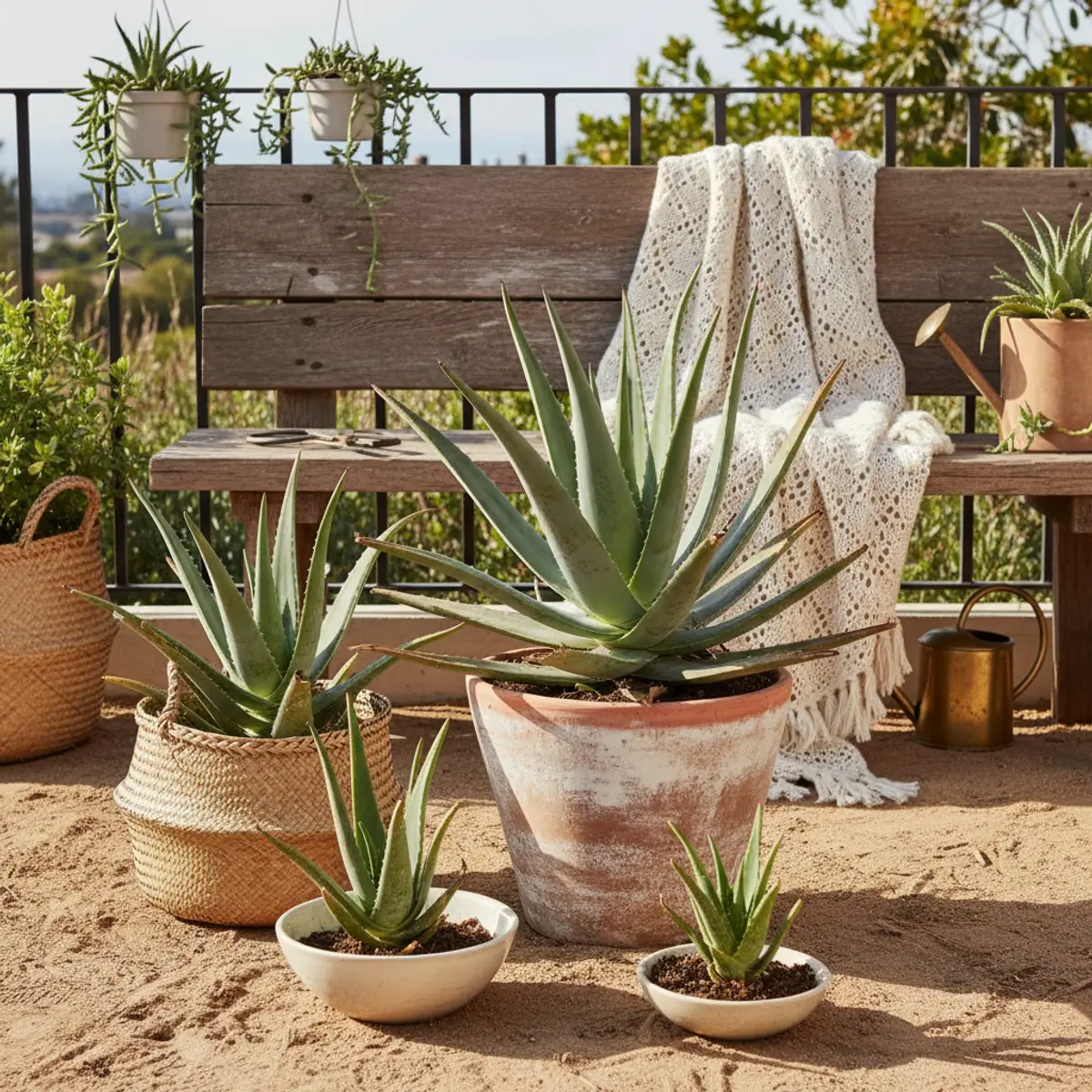
Aloe Vera Outdoors: Growing in the Garden or on a Balcony
Grow your aloe vera outdoors successfully. Balcony, patio or garden: location, winter protection and advice for every season.
Last summer, I put three of my aloe vera plants on the south-facing balcony without taking any precautions. I brought them out one morning in April and placed them directly in full sun. The result? Within 48 hours, the leaves exposed to the sun were covered in white and brown spots. Sunburn. My plants, used to the filtered light of an apartment, had received a severe shock.
Since then, I have learned my lesson. Aloe vera loves the outdoors — natural brightness, air circulation and the temperature changes between day and night — but the transition must be gradual, and certain precautions are essential depending on your region and setup.
Here is everything you need to know to grow aloe vera outdoors, whether on a balcony, a patio or in the ground in your garden.
Can aloe vera grow outdoors everywhere in France?
This question comes up constantly, and the answer is nuanced. Aloe vera is a tropical plant native to the Arabian Peninsula and does not tolerate frost. In France, year-round outdoor growing is possible only in a few favoured areas.
Areas where aloe vera can stay outside all year
- The French Riviera and Mediterranean coast: mild winters (rarely below 5 °C) make growing in the ground or permanently in a pot outdoors possible
- Corsica: the same applies, with often ideal conditions
- The Arcachon Basin and the Basque coast: possible in sheltered locations, but more risky
Areas where the plant must be brought in for winter
- Everywhere else in mainland France: as soon as night temperatures regularly fall below 10 °C (usually between October and April), bring your aloe vera plants indoors. To learn how to care for them during this period, see my guide to growing aloe vera indoors
Absolute limits
- Below 5 °C: leaf cells begin to freeze, and the damage is visible (soft, brown, translucent leaves)
- Below 0 °C: the plant dies, even briefly. A single frost event is enough to kill it
- Winter humidity: damp cold is worse than dry cold. Aloe vera may tolerate 5 °C in a dry climate, but suffer at 8 °C in a wet, rainy region
Growing aloe vera on a balcony or patio
This is the most common situation: putting potted aloe vera outside when the weather improves. It is also where the results are most spectacular. An aloe vera that spends the summer outdoors will be more vigorous, more colourful and produce more offshoots than one that stays indoors all year.
Choosing the right location
- South or south-west facing: ideal for maximum sunshine
- Sheltered from the wind: aloe vera does not like strong, constant winds, which dry out its leaves and can make it topple
- Protected from direct rain: if possible, place your pots under an awning or ledge that protects them from prolonged showers. Aloe vera tolerates occasional rain, but several days of continuous rain in a pot without optimal drainage is disastrous
The indoor-to-outdoor transition: the critical step
This is where I made my mistake the first year. Here is the method I now use successfully:
Week 1: place your aloe vera outside in the shade for a few hours a day, then bring it in at night
Week 2: increase the time outdoors. Keep it in the shade or in gentle morning light (sun before 10 a.m.)
Week 3: leave it outside permanently, still in gentle light or morning sun
Week 4: gradually introduce direct afternoon sun. By the end of the week, the plant will be acclimatised
This four-week acclimatisation may seem long, but it prevents sunburn and stress. A sunburned plant takes months to recover. Four weeks of patience are better than four months of convalescence.
When should you take it out and bring it in?
- Taking it out: when night temperatures remain steadily above 10 °C. In the Paris region, this is usually mid-May. In the south, it can be as early as April
- Bringing it in: when nights regularly fall below 10 °C. September or October depending on the region. Do not wait for the first frost — by then it is already too late
Growing aloe vera in the ground
For those who live in regions with a mild enough climate, planting aloe vera in the ground is a wonderful experience. The plant can reach impressive sizes that it never achieves in a pot.
Preparing the soil
Soil is the most important factor. Aloe vera needs excellent drainage. Clay soil that holds water is its worst enemy.
- Ideal soil: sandy, stony and well drained. If your garden is naturally rocky, that is perfect
- Clay soil: dig a hole 50 cm deep and wide, fill the bottom with 15 cm of gravel, then add a mixture of half garden soil and half coarse sand and fine gravel
- Sloping ground: even better. Water drains naturally and never pools around the roots
The garden location
- Full sun: unlike pot growing, where sun through glass can cause scorching, aloe vera enjoys direct sun outdoors once acclimatised
- At the foot of a south-facing wall: ideal. The wall reflects heat and protects the plant from cold wind. In winter, it can be 2 to 3 degrees warmer than in the middle of the garden
- Rock garden: aloe vera pairs perfectly with a rock garden, alongside sedums, agaves and other succulents
Planting step by step
- Dig a hole twice as wide as the root ball
- Place a layer of drainage material at the bottom (gravel, pumice)
- Mix the excavated soil with coarse sand (a 50/50 ratio for ordinary soil)
- Plant the aloe vera without burying the base of the leaves — the crown must remain above soil level
- Do not water for a week, so any injured roots can heal
- Mulch with mineral gravel (not organic mulch, which retains moisture)
Watering aloe vera outdoors: what changes
Outdoor watering follows the same principles as indoor watering — wait for the medium to dry out thoroughly before watering — but there are a few specific points. For the general principles, see the complete watering guide.
In a pot on the balcony
- Evaporation is faster than indoors because of wind and direct sun. You will water more often in summer: every 5 to 7 days is not unusual
- After rain, check that the saucer is empty. Remove it completely if a rainy period is forecast
- Morning is the best time to water: the water has time to soak in before the heat of the day
In the ground
- Once well established (after the first year), aloe vera planted in the ground in southern France rarely needs additional watering. Rain is usually enough
- During a heatwave, deep watering every 2 to 3 weeks may be beneficial
- Never water if rain is expected in the next few days
Protecting aloe vera from bad weather
Prolonged rain
This is the number one outdoor danger, more so than cold in many cases. An aloe vera in a pot under continuous rain for several days can develop root rot in less than a week.
Solutions:
- Remove saucers during rainy periods
- Move pots under shelter if the rain lasts more than 2–3 days
- In the ground, soil drainage is your only protection — which is why preparing the soil properly before planting is so important
Wind
Violent gusts can break leaves and knock over pots. Protect your aloe vera with a natural windbreak (hedge, wall) or bring pots indoors when storms are forecast.
Hail
Even moderate hail tears aloe vera’s fleshy leaves. If hail is forecast, bring pots inside or cover plants in the ground with a winter fleece.
Overwintering outdoor aloe vera
In a pot: bringing it indoors for winter
When temperatures drop, bring your pots indoors gradually. Ideally, use a cool (10 to 15 °C), bright room with little watering. An unheated conservatory is perfect.
Do not wait until the last moment. An aloe vera that experiences even a mild cold snap (below 5 °C) will take weeks to recover, with leaves that become soft and brown.
In the ground: protecting it in place
In areas where aloe vera can remain outside but cold spells are possible:
- Winter fleece: cover the plant on nights when frost is forecast. Remove the fleece as soon as temperatures rise
- Mineral mulch: surround the plant’s base with gravel or pumice to insulate the roots from cold
- Reduce watering: a dry aloe vera withstands cold much better than one full of water. Water-filled cells freeze and burst more easily
Propagating outdoor aloe vera
An aloe vera that spends the summer outdoors often produces many more offshoots than an indoor plant. The vigour provided by natural light and temperature changes stimulates propagation. If you want to take advantage of this abundance, see the aloe vera care guide to learn about the right timing and best practices.
Key points to remember
Outdoor aloe vera is a transformed plant: more vigorous, more colourful and more generous with offshoots. But success depends on a few essential rules.
Acclimatise it gradually over four weeks in spring. Protect it from prolonged rain and wind. Ensure excellent drainage, whether it is in a pot or in the ground. Above all, plan for bringing it in for winter: do not wait for the first cold snap.
If you are looking for more information about daily care, the complete aloe vera care guide covers all the basics. And to optimise watering according to the seasons, I have a dedicated article that complements this outdoor guide perfectly.
Your aloe vera plants will thank you for this season in the fresh air — trust me, the difference is spectacular.
Ces articles pourraient aussi vous plaire
 entretien
 Aloe Vera d'Intérieur : Guide Complet pour une Plante en Pleine Santé
Tous les conseils pour reussir votre aloe vera en intérieur : emplacement, lumiere, temperature et erreurs a eviter pour une plante resplendissante.
 entretien
 Quel Pot pour un Aloe Vera ? Taille, Materiau et Drainage
Choisir le bon pot pour votre aloe vera : terre cuite, plastique, taille ideale et drainage. Tout ce qu'il faut savoir pour eviter les erreurs.
 entretien
 Multiplier un Aloe Vera : Toutes les Methodes Pas a Pas
Apprenez a multiplier votre aloe vera par rejets, division ou feuille. Guide complet avec toutes les methodes, etape par etape.
Newsletter
Rejoignez notre communauté de passionnés
Restez informé
Recevez nos conseils aloe vera
Inscrivez-vous pour recevoir nos meilleurs articles et astuces sur l'aloe vera directement dans votre boîte mail.
Pas de spam. Désabonnement à tout moment.